
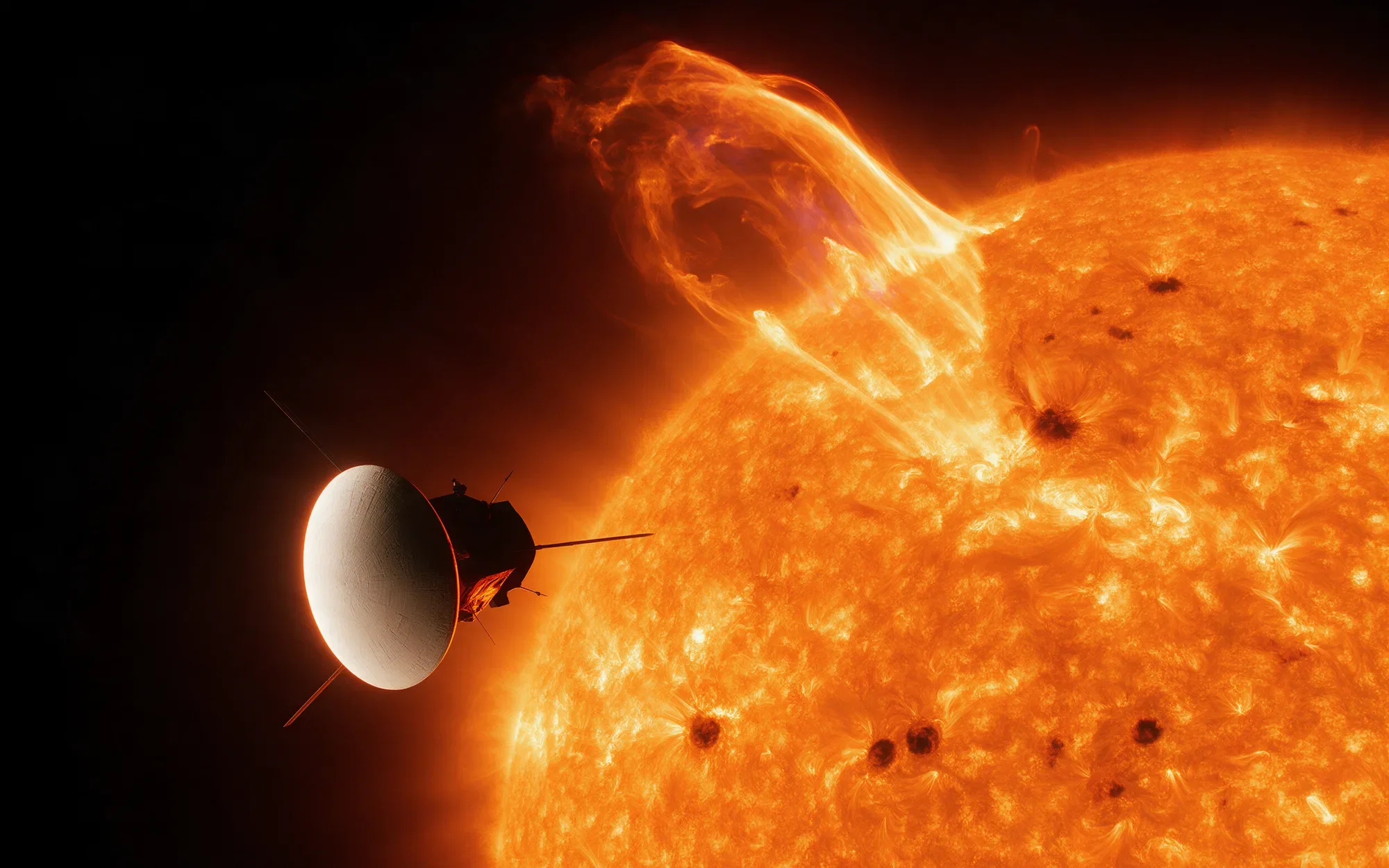
On Christmas Eve 2024, a spacecraft the size of a small car passed closer to the Sun than any human-made object ever had. NASA's Parker Solar Probe swept through the Sun's outer atmosphere, the corona, at a distance of about six million kilometres from its visible surface, moving faster than any spacecraft in history. For a few hours it was, in a real sense, touching a star.
The mission had been decades in the making. Scientists first proposed sending a probe into the corona in the 1950s, but the engineering problems were enormous. It took new materials, new navigation techniques and a series of gravity assists from Venus to make it possible.
Why go so close?
The Sun is the most important object in our sky, yet some of its most basic behaviour remains puzzling. Its visible surface is around 5,500 degrees Celsius, but the corona above it reaches more than a million degrees. Something heats that thin outer layer far beyond the temperature of the surface beneath it, and scientists have argued for decades about what.
A second puzzle is the solar wind, the stream of charged particles that flows outward from the Sun in every direction. It shapes the space environment of the whole solar system. Near the Sun it accelerates to hundreds of kilometres per second, but how and where that acceleration happens has been difficult to pin down from a distance.
Measuring the corona from Earth is like studying a waterfall from a mountain away. Parker went and stood in the spray.
Surviving the heat
The probe's survival depends on a heat shield about eleven centimetres thick, made of a carbon foam sandwiched between carbon-composite sheets and painted white on the side facing the Sun. During close passes, the front of the shield reaches well over a thousand degrees Celsius. Behind it, the instruments stay near room temperature.
Keeping the shield pointed correctly is critical. The spacecraft is too far away for controllers on Earth to steer it in real time, so it makes its own decisions. Sensors around the edge of the shield detect any sunlight creeping past, and the onboard computer adjusts the spacecraft's orientation within seconds.
Faster than anything before
At its closest approaches, Parker travels at roughly 690,000 kilometres per hour. That speed comes not from its engines but from falling toward the Sun on a tightening orbit, each pass shaped by a carefully planned flyby of Venus that drains a little of its orbital energy.
What it has found
Even before its record-setting passes, Parker had changed how scientists think about the solar wind. It found that the wind near the Sun is far more turbulent than expected, full of sudden reversals in the magnetic field that researchers call switchbacks. These kinks appear to originate low in the corona and may be a clue to how the wind is heated and accelerated.
The probe has also flown through dust-free regions close to the Sun, confirming a long-predicted zone where heat vaporises the fine dust that fills the inner solar system. And it has recorded radio bursts and energetic particles from solar eruptions at close range, providing measurements that help improve forecasts of space weather.
Why it matters on Earth
Space weather is not an abstract concern. Large solar storms can disrupt satellites, degrade GPS signals, interfere with radio communications and, in extreme cases, damage power grids. As more of daily life depends on satellites, from navigation to payments, better forecasts become more valuable.
Missions like Parker provide the physics that forecasting models need. Combined with observations from solar observatories on the ground and in space, including India's own Aditya-L1, they help scientists understand how disturbances form near the Sun and how they travel outward.
Working with other missions
Parker does not work alone. Europe's Solar Orbiter, launched in 2020, takes images of the Sun from a slightly greater distance and from angles that reveal its polar regions. When the two spacecraft line up, scientists can watch a feature on the Sun's surface with Solar Orbiter's cameras and then measure the solar wind it produces as that wind washes over Parker, connecting cause and effect in a way neither mission could manage on its own.
A daring touch
Parker Solar Probe will keep orbiting the Sun until its fuel runs out, eventually losing its ability to keep the heat shield pointed correctly. When that happens, parts of it may continue to circle the Sun for a very long time, a small artefact of human curiosity left in the star's outer atmosphere.
Until then, each close pass adds to a dataset that scientists will study for decades. The questions it set out to answer are not yet fully settled. But for the first time, those questions are being asked with measurements taken inside the corona itself.
 Hari Dhruvalok