


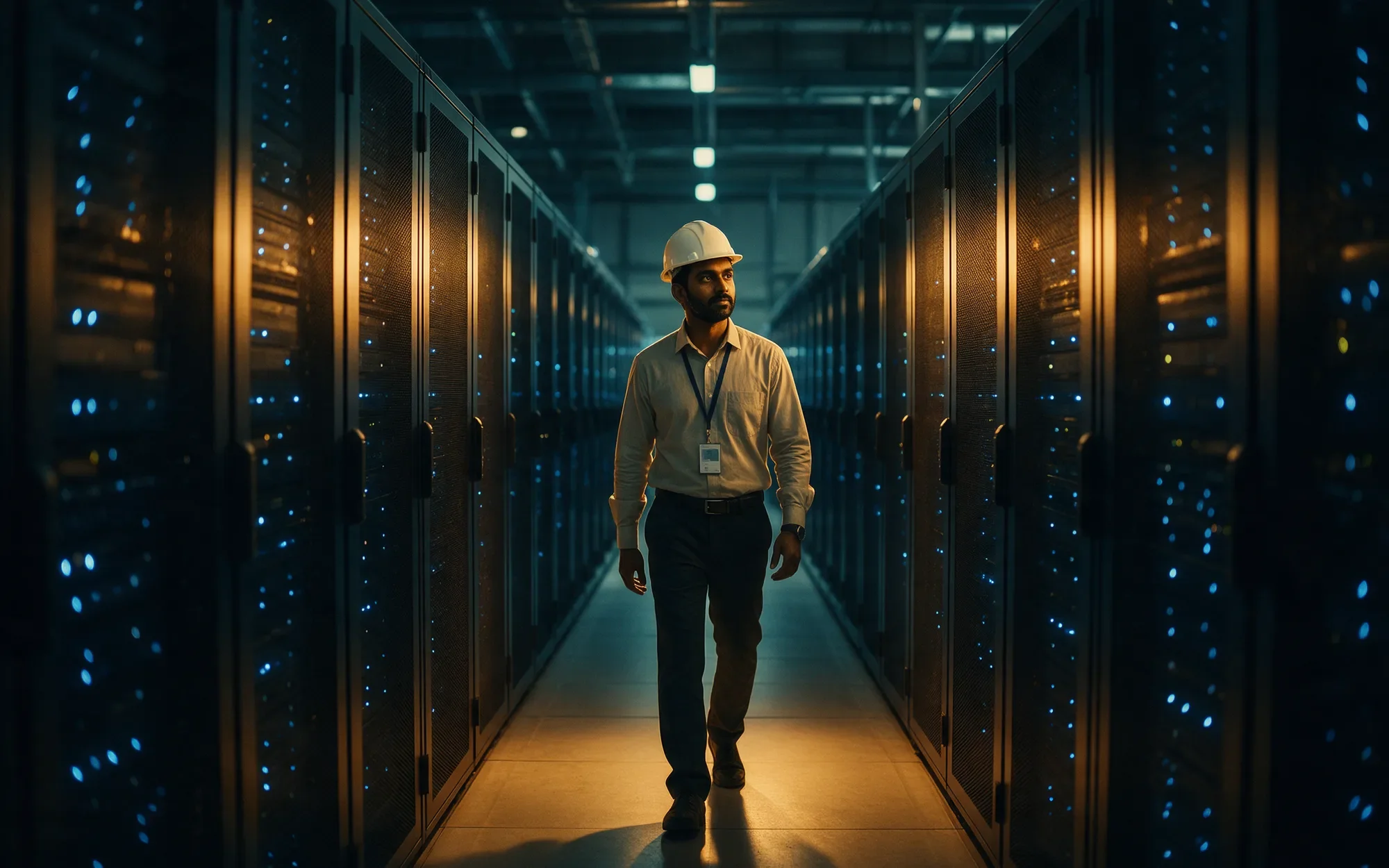
Every conversation about artificial intelligence eventually arrives at the same practical question: where will the computing power come from? Training a large model, or even serving a popular one to millions of users, requires racks of specialised chips, enormous amounts of electricity and the cooling to keep it all running. For years Indian companies rented that capacity from cloud providers abroad. That is beginning to change.
A wave of new data centres is rising around Mumbai, Chennai, Hyderabad and the National Capital Region, and a growing share of the floor space is being designed specifically for AI workloads. Operators are installing liquid cooling, negotiating long-term power contracts and, in some cases, building their own substations.
Why location matters
There are three reasons Indian organisations increasingly want compute at home. The first is latency: applications that respond to users in real time, such as voice assistants or fraud checks, work better when the servers are close. The second is regulation: banks, hospitals and government departments face rules about where certain data may be stored and processed. The third is cost, or more precisely currency risk. Paying for compute in rupees removes one source of uncertainty from a startup's budget.
Public programmes have added momentum by subsidising access to shared GPU clusters for researchers and early-stage companies. The idea is to let a student or a five-person startup experiment with large models without first raising millions of dollars. Early users describe the access as uneven but genuinely useful, especially for fine-tuning open models on Indian-language data.
“A year ago we spent half our seed round on cloud bills. Now we can book a cluster for a week, run our experiments and get back to building the product.” — Siddharth Kulkarni, co-founder of an AI startup in Pune (fictional, for this demo)
The power problem
The single biggest constraint on AI data centres is electricity. A modern AI rack can draw many times the power of a conventional server rack, and a large facility can consume as much electricity as a small city. In a country where peak demand is already rising quickly, that raises hard questions about grid capacity, pricing and emissions.
Operators are responding in several ways. Some are signing agreements to buy solar and wind power directly from developers. Others are locating new campuses near transmission corridors or in states with surplus renewable capacity. A few are experimenting with on-site storage to smooth demand. None of these is a complete solution, but together they suggest the industry understands that power, not chips, may become the binding constraint.
Water and cooling
Cooling is the other side of the same coin. Traditional evaporative systems use large amounts of water, a serious concern in cities that face shortages every summer. Newer designs circulate liquid directly over the chips in a closed loop, using far less water and allowing denser racks. They cost more to build but are becoming the default for new AI halls.
Opportunities beyond the racks
The buildout is creating opportunities well beyond the data centres themselves. Engineering firms are designing cooling systems and power equipment. Software startups are building tools to schedule workloads, monitor energy use and share capacity among many small customers. Training institutes are running courses for technicians who can maintain high-density facilities, a skill in short supply.
For enterprises, local capacity changes the economics of AI projects. Workloads that were too expensive or too sensitive to send abroad become feasible. Several large companies are now designing hybrid setups, keeping sensitive data and steady workloads in Indian facilities while bursting to global clouds when demand spikes.
Who gets access
The question of access may matter as much as the quantity of compute. Large enterprises can sign multi-year contracts for dedicated capacity. Universities, small startups and independent researchers cannot. Shared clusters, booking systems and credits for academic work are attempts to spread capacity more widely, and their design will shape who gets to build the next generation of Indian AI products.
Some operators are experimenting with marketplaces that let customers rent idle capacity for hours rather than months. Others are offering managed fine-tuning services, so that a company with data but no machine-learning team can still adapt a model to its needs.
What comes next
The next phase will test whether the buildout can keep pace with demand without overbuilding. Data centres take years to plan and construct, and the chips inside them become outdated quickly. Operators must bet on how much capacity AI will really need in five years, and on which kinds of chips will run it. Some of those bets will be wrong.
Still, the direction is clear. Compute is becoming a strategic asset, like ports or power plants, and India is building its own. If the country can pair that infrastructure with affordable access for researchers and startups, the payoff could be a generation of AI products designed for Indian users from the ground up.

 Hari Dhruvalok